April 2026

North America
·Manhattan office bifurcation deepens as trophy rents top $320/sq ft and Penn District absorbs a quarter of relocations. Manhattan's office recovery is consolidating around a narrow set of trophy assets and modernised submarkets, with two recent leases pushing top-tier rents beyond $320 per square foot and a Cushman & Wakefield study confirming the Penn District as the city's dominant relocation destination. An unidentified international family office has signed a 10-year lease averaging $327.50/sq ft for 5,063 sq ft on the 50th floor of Soloviev Group's 9 W. 57th St., described as a citywide record, narrowly ahead of a 7,204 sq ft, five-year deal at SL Green's One Vanderbilt to Nvidia-backed AI infrastructure firm Nscale at a $320 starting rent. The pricing reflects acute trophy scarcity rather than broad market strength, with Manhattan's trophy vacancy at 6.3% in Q1 against an overall office vacancy of 13.3% per CoStar, while Q1 leasing of 12.4m sq ft per Savills was the strongest quarter since Q4 2019. The Penn Station submarket has captured almost a quarter of all Manhattan relocations from 2023-2025, drawing more than 3.5m sq ft, 83.2% of it from neighbouring Midtown submarkets, split across financial services (24%), professional services (23.7%), technology (18.8%) and media (10.7%). Vornado Realty Trust's Penn 2 anchors the trade, with 2025 leasing of 908,000 sq ft at $109/sq ft starting rents on 17-year average terms taking the building to 80% occupancy and submarket asking rents now sit 37.8% above the Midtown average. (Source: Commercial Observer, CoStar, Savills, Cushman & Wakefield, JLL, CBRE, 2026)
SL Green Realty’s trophy tower One Vanderbilt on Madison Avenue, Midtown Manhattan

·London-New York office construction gap hits 20-year record as supply pipelines diverge. The construction differential between London and New York's office markets reached its widest level in at least two decades in H2 2025, with London's pipeline at over 16m sq ft against just 5.7m sq ft in New York, according to CoStar Analytics. New York's pipeline has more than halved from its 2018 peak, when it ran at more than double London's, with 2025 starts of just under 4m sq ft remaining well below the 8m sq ft annual average across 2014-2019. The US capital's developers have decisively shifted to a pre-leased model, illustrated by 2 World Trade Center, a stalled 2m sq ft scheme that only moved forward this spring after American Express committed to take the entire building in February 2026, and 3 Hudson Boulevard, the 1.9m sq ft Hudson Yards tower paused since 2022 pending an anchor. London, by contrast, has held pipeline volumes between 16-17m sq ft since 2022, supported by 14 new lettings of more than 100,000 sq ft in 2025, the joint-highest total since 2017 and double the 2024 level. The crucial structural distinction is that London's large-unit demand has been focused on pipeline stock, whereas the bulk of New York's 59 sub-100,000 sq ft+ deals in 2025, totalling over 14m sq ft and led by Bank of America's 2.1m sq ft renewal and expansion at One Bryant Park, were absorbed into existing buildings. The gap is expected to narrow over the next two years, with London construction starts falling to 15-year lows and Q1 2026 preliminary data showing pipeline volumes below 16m sq ft for only the third time since 2021. (Source: CoStar, 2026)
Office Construction Volume between New York and London (as of Q1 2026)

·Blackstone flags supply collapse as Q1 results show muted real estate performance. Blackstone has flagged "a collapse in new supply" across major real estate sectors as a structural tailwind for its portfolio, with CFO Michael Chae telling analysts on the Q1 earnings call that 2026 deliveries in logistics and multifamily are tracking at their lowest level in 12 years. Headline performance remained subdued in the quarter, with the firm's opportunistic funds posting a 0.6% annual decline and core-plus real estate appreciating 3%, as strength in data centres was offset by weakness in life sciences offices and Blackstone's listed Indian holdings. BREIT, the firm's $300bn-plus US non-traded REIT, delivered 8.1% returns for 2025 and raised $1.2bn in Q1, its strongest quarterly inflow in three years, with president and COO Jonathan Gray attributing resilience to portfolio positioning including a 23% data centre weighting. Total real estate inflows reached $6.8bn in the quarter, though group real estate AuM edged down to $315bn from $319bn at end-2025 as redemptions and mark-to-market continued to weigh on the balance. Chae also pointed to record US logistics leasing pipeline activity, reinforcing the supply-side thesis as the principal driver of the firm's constructive forward view on warehouse and rented residential fundamentals. (Source: Blackstone, Green Street, 2026)
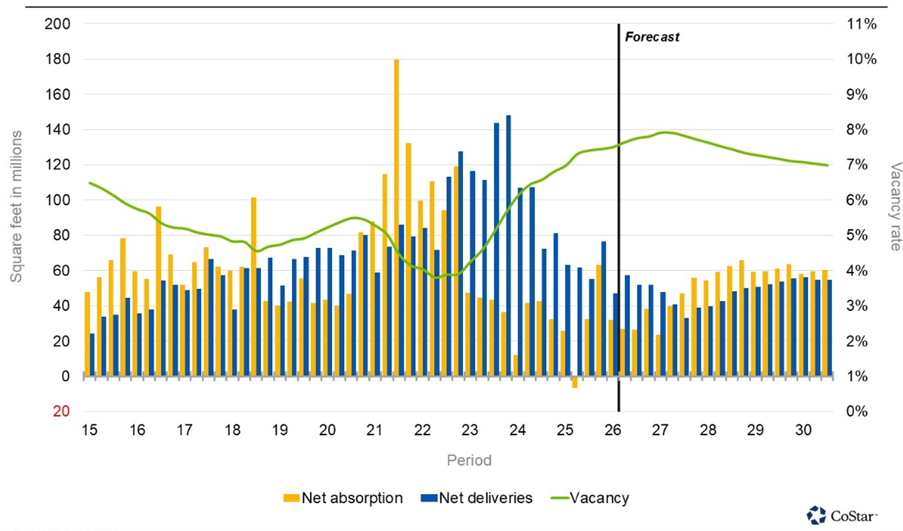
·US industrial demand to overtake supply by early 2027 as vacancy peaks and rents reaccelerate. US industrial demand is set to overtake new supply by early 2027, marking the inflection point that ends the post-pandemic period of oversupply that has weighed on warehouse owners since 2022, according to CoStar's latest forecast. The national vacancy rate is expected to hold in the mid-7% range entering Q2 2026 and drift higher into early 2027 toward the upper-7% range before beginning a gradual descent, with the inflection point now pushed back by a quarter relative to the prior forecast as macro conditions soften. Rent growth assumptions have been revised down accordingly, with average annual gains of 1.6% now expected across 2026-2027 against the 2.2% previously projected, before a recovery toward 2% annual growth by late 2027. Net absorption is forecast to track the prior outlook, supported by healthy H2 2025 leasing. Risks remain skewed to the downside, with US trade policy volatility, rising tenant operating costs and softer goods spending potentially driving vacancy to overshoot toward 8-9% and producing a deeper drag on rents. (Source: CoStar, 2026)
US industrial vacancy forecasted to peak in 2027
·Hilton CEO flags hospitality "sea change" as Q1 RevPAR beat backs up the call. Hilton president and CEO Christopher Nassetta argued that hospitality is approaching a multi-year inflection, telling owners that "the setup over the next seven years is going to be very, very different and much, much better" despite acknowledged near-term margin pressure from anaemic same-store revenue growth and persistent expense inflation. Nassetta pointed to AI-driven productivity gains as the catalyst for a flattening of the K-shaped bifurcated consumer economy and a reacceleration of broader US growth. The forward call gained empirical support today with Hilton's Q1 2026 results, which showed system-wide comparable RevPAR up 3.6% on a currency-neutral basis on gains in both occupancy and ADR, well ahead of the 1-2% the company had guided. Management and franchise fee revenues rose 10.4% year-on-year, adjusted EBITDA reached $901m against $795m a year earlier, and the group raised full-year 2026 RevPAR guidance to 2-3% with adjusted EBITDA now expected at $4.02-$4.06bn. The bifurcation thesis is increasingly central to lodging underwriting: RevPAR growth at the high end is far outpacing other segments, with the top 10% of earners accounting for nearly half of all spending in mid-2025, a dynamic that disproportionately benefits asset-light brand owners with concentrated luxury exposure over leveraged mid-market real estate holders. (Source: Hilton, CoStar, 2026)
Hilton President, Christopher Nassetta, at the 2026 Hunter Conference

Europe
·AEW forecasts prime offices and shopping centres to lead European returns through 2030. European prime offices are forecast to deliver the highest total returns of any commercial real estate sector over the next five years at 10% a year, followed by shopping centres at 8.9% and logistics at 8.5%, according to AEW's 2026 Mid-Year European Outlook. Residential and high street retail are projected to round out the table at 7.7% and 7.2% respectively, with prime office yields seen tightening by 40 basis points by 2030 and supported by rental growth of 3%, overtaking residential at 2.9%, logistics at 2.3% and shopping centres at 1.7%. AEW estimates the Middle East conflict will trim total returns by only 10 basis points per annum on a base case of 1.5% European GDP growth, with the gap between downside and base case scenarios a modest 1.1% per annum. Transaction volumes reached €209bn in 2025, up 6% on 2024's €197bn and ahead of expectations, though AEW expects momentum to slow in H1 2026 as investors defer decisions before activity resumes later in the recovery cycle. Declining new supply is a central pillar of the thesis, with office and logistics vacancy rates forecast to fall to 9% and 6% respectively by end-2030, and head of research Hans Vrensen flagging income growth as the key driver of total returns over the period. (Source: AEW, Green Street, 2026)
·La Défense distress deepens as Emblem and Tour Europe join the market. Two further La Défense towers have been put up for sale at valuations well below acquisition cost, underscoring the depth of repricing in Paris's principal business district. Invesco and RedTree Capital, alongside lenders Société Générale, AEW and BNP Paribas, are seeking around €100m for the 27,000 sq m Emblem tower, below the roughly €130m of senior and junior debt outstanding against an asset into which the partners invested close to €200m following a 2017 acquisition from Deka and a refurbishment completed in 2021. Separately, Iroko Zen, the French retail-funded unlisted real estate vehicle structure has emerged as frontrunner to acquire the 28,000 sq m Tour Europe from Korea Investment & Securities (KIS) for €80m-€90m, against the roughly €280m KIS paid BlackRock for the building in 2022, implying a headline write-down approaching 70%. The repricing reflects a compound hit: sharply higher financing costs since 2022 expanding required yields, headline rents discounted by c.40% incentive packages to produce thin effective income, and persistent leasing voids preventing owners from stabilising assets to core-quality cash flows. Immostat data shows average rent incentives in La Défense at 40.1% versus 15.4% in the Paris CBD, while Knight Frank reported 2025 take-up of around 147,000 sq m, down 31% year-on-year and 18% below the ten-year average. (Source: Green Street, Immostat Data, 2026)
French SCPI, Iroko Zen, in position to acquire KIS owned Tour Europe

·Apollo to acquire Gatehouse Living, securing UK single-family rental scale. Apollo Global Management is set to acquire Gatehouse Living Group from Kuwaiti-owned Gatehouse Bank in a deal expected to sign today, handing the US private capital giant control of the UK's largest single-family rental management platform. The transaction covers both arms of the business, Gatehouse Investment Management and property manager Ascend, which oversees more than 12,000 units. Gatehouse has deployed roughly £1bn for blue-chip investors including Goldman Sachs, Kuwait Investment Authority (KIA) and TPG, and continues to invest for Carlyle, though a £270m portfolio sale from that mandate is in progress and Greykite, a London-based manager targeting a £750m UK portfolio. Ascend's existing mandates include PRS REIT, now jointly owned by Northern LGPS and Local Pensions Partnership Investments, and Lloyds Living, which has acquired more than 1,400 homes via two transactions from TPG- and KIA-backed vehicles previously managed by Gatehouse. The deal layers onto Apollo's existing UK residential exposure, which includes housebuilders Miller Homes, bought from Bridgepoint for £1.2bn in late 2021 and St Modwen Homes, acquired from Blackstone for £215m in late 2024, though neither will be vertically integrated with Ascend. For investors, the transaction signals that UK single-family rental is consolidating from a fragmented, deal-by-deal opportunity into permanent-capital-backed operating platforms, with Apollo joining a narrow group capable of writing both the platform and the development cheque (Source: Green Street, 2026).
Gatehouse Investment Management and Ascend manages 12,000 units across 150 locations and is the largest manager of single-family stock in the UK.

·Accor exits European hotel platform, Essendi, as Blackstone and Colony IM lead €975m consortium buyout. Accor has agreed to sell its 30.56% stake in Essendi, the 559-asset European hotel platform formerly known as AccorInvest, to a consortium led by Blackstone and Colony Investment Management (Colony IM), in a transaction valuing the holding at up to €975m. The structure comprises €675m payable on close with an earn-out of up to €300m, landing above the €750m-€800m range Green Street News had previously reported Accor was targeting. As part of the deal, Essendi's portfolio will be converted onto franchise contracts with Accor, completing the operator's pivot to a capital-light, fee-driven model and severing its remaining real estate exposure to the platform. The portfolio spans 89,588 rooms across 22 countries, with roughly a third in France and material weightings in the UK, Germany, Spain and Italy, dominated by budget and midscale brands including Ibis, Novotel and Mercure alongside a handful of Sofitel and MGallery upscale assets. Colony IM already owns around 22% of Essendi, and the acquisition will require support from co-shareholders GIC, Saudi PIF, Amundi and Crédit Agricole Assurances, with closing slated for Q3 2026 subject to Blackstone and Essendi shareholder approval. The transaction marks one of the largest European hotel platform trades since the post-Covid recovery and gives Blackstone scaled exposure to budget-led European lodging at a moment when select-service economics have outperformed full-service across the cycle. (Source: Accor, Colony, Essendi, 2026)
Accor to sell its interest in European budget brands portfolio to Blackstone and Colony IM.

·Knight Frank flags $144bn institutional capital re-entry as private capital extends four-year lead. Around $144bn of institutional capital is preparing to re-enter the global commercial real estate market in 2026, according to Knight Frank's latest Wealth Report, marking a notable inflection after a multi-year period of muted allocation. Private capital, high-net-worth individuals and family offices, remains the dominant force, having been the largest buyers of global CRE for four consecutive years and deploying $464bn in 2025 against $347bn from institutional investors. The agency attributes the shift to fundamentals rather than headlines, with only 15% of survey respondents (representing $1.4tr of AuM) citing domestic politics as a key investment driver and just 5% pointing to regulation and tax. Nick Braybrook, global head of capital markets at Knight Frank, noted that repricing, supply-demand dynamics, stabilising interest rates and improving income visibility were drawing capital back, with private capital continuing to set the pace via its flexibility and speed of execution. The UK is singled out as continuing to attract strong interest despite negative sentiment, highlighting a disconnect between perception and actual allocation that has persisted across recent quarters. (Source: Knight Frank, Green Street, 2026)
London attracted the largest commercial real estate investment allocation in 2025


Comments